MOVIE REVIEWS |
INTERVIEWS |
YOUTUBE |
NEWS
|
EDITORIALS | EVENTS |
AUDIO |
ESSAYS |
ARCHIVES |
CONTACT
|
PHOTOS |
COMING SOON|
EXAMINER.COM FILM ARTICLES
||HOME

Wednesday, January 22, 2013
MOVIE REVIEW The Wolf Of
Wall Street
It's Not About Belfort. It's About Us, U.S. And All Of Us
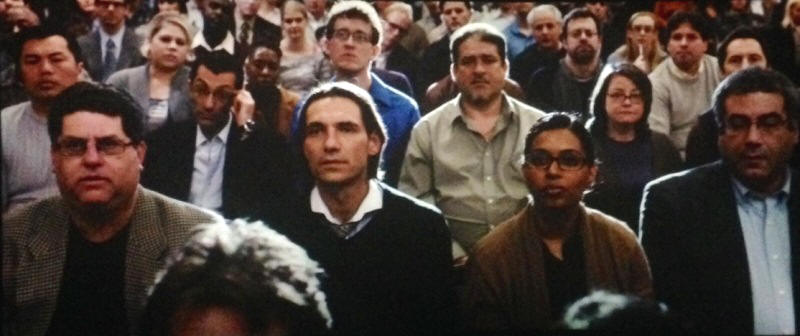
The audience in "The Wolf Of Wall Street". Quite simply, the audience,
namely us the moviegoer, is on trial.
Paramount
by
Omar P.L. Moore/PopcornReel.com
 FOLLOW
Thursday,
November 23,
2013
"Money makes you a better person," insists Jordan Belfort
(Leonardo DiCaprio) in "The Wolf Of Wall Street", Martin Scorsese's wild,
orgiastic masterwork of salesmanship and con. Every assertion by Belfort
renders him a most unreliable narrator. Belfort, a sociopath on the order
of Patrick Bateman sans murders, is as obsessed with money as his iconic 1980s
cousin is with business cards, pissed he made less than a million dollars a week
in his first year as a stockbroker by pushing the hard sell of weak stocks on
poor, rich and old alike.
Belfort cheats on his wives with hookers of all races and economic stratum.
He cheats his clients, who've read The Wall Street Journal too late to realize
he has their money in his pockets. "I just know how to spend it better,"
he declares. Soon he starts his own brokerage firm, Stratton Oakmont, Inc.
Belfort's legend is born as is his extreme drug addiction.
Full of contradictions, the film is about the times we live now and have lived
in since humankind started: greed, avarice and selfishness. In short, "The
Wolf Of Wall Street" is an epic cartoon reel of debauchery, sex and hustle.
Its absurd romp of excess is executed to disturbing effect in two early scenes.
One is of a female employee at Belfort's self-made firm Stratton Oakmont who
gets her head shaved for $10,000 on the firm's trading floor. "She's
already a C cup but she wants Double-D's!", Belfort shouts. As her locks
are shorn, you think of a Jewish woman being shaved before being marched to the
gas chamber in the late 1930s.
As Howlin' Wolf's classic "Smokestack Lightning" plays to haunting,
hallucinogenic effect as a satricial overlay plays: the American way of Super
Bowl-like pre-game entertainment: scores of cheerleaders, then near-naked
strippers, hookers and band-marching Stratton employees hurtling through the
frame on a collision course in unsettling fashion as "Stars And Stripes Forever"
has been playing moments before, and dementedly. It's creepy overkill, and
deliberate. You might think of the Tailhook Scandal or the misogyny rife
on trading floors. (I worked on one for several years at the same time Mr.
Belfort did. And I saw too much.)
Mr. Wolf's song returns in the same scene to compete with "Stars", fighting for
volume supremacy on the soundtrack. It's a very shrewd duel between
African-American Blues music, and the patriotic tones of "Stars And Stripes", a
very fight for the soul of sanity and reason both in the scene and in the larger
metaphorical American conscience. "Oh, don't you hear me crying," Mr. Wolf
croons on "Smokestack", as chaos reigns. It's as if he's crying out in the
pain a Bluesman feels, for morality and order as decadence cascades. He is
the last voice of true patriotism, as the subverted American dream has
reasserted itself as the new old cultural language. Its deeper more
powerful implication however, is slavery, and Wall Street's role in it.
This is caught in a line in another scene in which a firm's lawyer speaks of
midget-tossing in the office: "If we don't consider them as human beings but
view it as an act..."
Mr. Wolf will be heard later in a Las Vegas scene, where $2 million worth of
damage was done from an orgy and drunkenness and paid for by Belfort, who has
the audacity to later call a colleague an "irresponsible little prick".
The level of self-denial and loathing is deep.
Still, Mr. Scorsese isn't judging his characters he isn't even judging the rich
- he's cynically showcasing the lie of advertising and its slick product and a
smooth talker to send people over the edge of a cliff. Various ads are
shown, each a lie in its own right. Characters mock the ads of their
companies in the magazines of Hustler and Popular Mechanics. The ad that
opens the film is the biggest lie of all, and it is blatantly modeled after a
Dreyfus TV commercial from the early 1990s. An infomercial tantamount to
the "Morrie's Wigs Don't Come Off" ad in "GoodFellas" is rudely interrupted.
Jordan Belfort is the pied populist of capitalism, exhorting, persuading in long
speeches with primal screams, and guttural Cro-Magnon fervor. He's the Jim
Jones and David Koresh of the financial markets. A televangelist of the
get rich quick school. Yet unlike Jimmy Swaggart, he never thinks he's
sinned. Money justifies it all. He taps into the post-2008 financial
crisis and scandals which no one has been jailed for. He penetrates the
viewer with appeals to "solve your problems by becoming rich." Isn't he
shrewd enough to know that there's little money to become rich with? Mr.
Scorsese's men want to make names for themselves, and see themselves as
inflatable movie stars in their own production. Jordan Belfort is Rupert
Pupkin 2.0, slicker, smoother, less lonely and more successful with the ladies,
yet perhaps poorer despite his riches.
For every film of its kind since "Wall Street", which opened just weeks before
the 1987 crash - "The Corporation", "Boiler Room", "Enron: The Smartest Guys In
The Room", "Inside Job", "Capitalism: A Love Story" and "Margin Call" - none has
shown the full-blooded id and decadence on screen like Mr. Scorsese's epic does.
The director's best film since "GoodFellas" unapologetically offers no
corrective characters and a refreshing absence of moralizing voices. That
assignment is left to us as an audience, the fourth wall Belfort occasionally
breaks through to. Is Belfort living the high life, or is he living out
self-loathing and self-destructive nightmares on a Groundhog Day basis? He
has cars and boats but they all end up destroyed. Do we envy him, like
him, or despise him?
Mr. DiCaprio is excellent here in his best work ever, and his charm offensive
keeps us laughing with him while feeling the guilt Mr. Scorsese normally allows
other characters in his films to feel. For years the director has mined
attraction-repulsion, guilt, monetary obsession, classism and men struggling to
find manhood through violence or through sex, or fear of not having it at all,
wrapped in a torrent of homophobia.
His nickname is a misnomer, since others had it before him. Yet Belfort
"Homefront", an odd title for this meaningless exercise, drifts aimlessly from
father-daughter story, to snarling drug big fish in small pond protecting his
turf story, to a group of third parties with their own agendas, to showdown
between Mr. Statham and Mr. Franco. Gator, an anti-drug drug dealer who
breaks a few bones of his own to protect his drug den, is an odious middle-man
stuck between a group of drug bandits led by Frank Grillo (whose talents are
wasted here) and the stoic Phil, who just wants to enjoy his home on the range
in peace. All are disconnected entities.
Gator's time is spent counting his drugs and wham-bamming his girlfriend Sheryl
(an unrecognizable Winona Ryder). As played by the ubiquitous Mr. Franco,
Gator is a sedated, rural edition of his Alien character from
"Spring
Breakers" earlier this year.
This swampy mess is not the fault of the actors -- it's the poorly-written
script by Mr. Stallone that crumbles faster than Gator's drug den. Some of
the cooks spoiling Mr. Fleder's film are indistinguishable. A virtual
write-off, "Homefront" will quickly recede from memory. Mr. Fleder, who
directed "Kiss The Girls", could just as well say "kiss my grits" to critics
with this expedient Southern B-movie tale. The biggest lesson of "Homefront",
whose poster has an American flag emblazoned on the back of Phil's denim jacket,
is that violence is oh so good -- just not in front of the kids, please.
Also with: Kate Bosworth, Marcus Hester, Omar Benson Miller, Clancy Brown,
Rachelle Lefevre, Pruitt Taylor Vince, Chuck Zito.
"Homefront" is rated R by the Motion Picture Association Of America
for strong violence, pervasive language, drug content and brief sexuality.
The film's running time is one hour and 40 minutes.
COPYRIGHT 2013. POPCORNREEL.COM. ALL RIGHTS RESERVED.
FOLLOW
MOVIE REVIEWS |
INTERVIEWS |
YOUTUBE |
NEWS
|
EDITORIALS | EVENTS |
AUDIO |
ESSAYS |
ARCHIVES |
CONTACT
| PHOTOS |
COMING SOON|
EXAMINER.COM FILM ARTICLES
||HOME