MOVIE REVIEWS |
INTERVIEWS |
YOUTUBE |
NEWS
|
EDITORIALS | EVENTS |
AUDIO |
ESSAYS |
ARCHIVES |
CONTACT
|
PHOTOS |
COMING SOON|
EXAMINER.COM FILM ARTICLES
||HOME

Tuesday, August 23, 2018
ESSAY
White Women As A Throughline In "BlacKkKlansman"

Scarlett O'Hara, played by Vivien Leigh, in Victor Fleming's "Gone With The
Wind".
MGM
by
Omar P.L. Moore/PopcornReel.com
 FOLLOW
Thursday,
August 23,
2018
WARNING: SPOILERS THROUGHOUT
This is the first in a series of essays on
"BlacKkKlansman".
The first scene: a white woman wanders through the detritus of dead and dying
bodies as far as the eye can see. A southern U.S. city (Atlanta) has been
destroyed in Civil War battle. The South has LOST. A torn
Confederate Battle Flag waves. Gone With The Wind.
Three other white women will be featured prominently enough during in Spike
Lee's excellent "BlacKkKlansman". One is a cover story actress of whom the
title character is told by a white male cop: "you know you want some of that!"
Another is a racist white woman, with a deadly agenda, a would-be member of the
all-white Daughters Of The Revolution 1930s-cum-1970s. (DAR didn't allow
Black women members for many years and is still struggling with its racist
issues and problems.) A third is a white woman in memoriam amidst a swarm
of bodies in another southern city. The juxtaposition of three of these
women appear to be a full-circle arrangement: white southern womanhood, white
woman on a pedestal (magazine cover) white woman who kills, white woman who is
killed.
White women are a discreet and major presence in "BlacKkKlansman",
ironically via their very sidelining. This sidelining isn't Mr. Lee's by
design but rather isin the way American history (as written by white men)
has marginalized or underestimated the impact white women have had specifically
as agents of racist behavior in bringing about the deaths of Black men and
women. This has been done by lying to white men about Black men, who would
be lynched. (Emmett Till is one of many.)
Harry Belafonte, who was rejected membership/attendance by DAR in the 1950s,
tells a real-life tale of a 14-year-old mentally challenged Black boy named
Jesse Washington, accused of raping a white woman. He didn't rape the
woman but was lynched then tortured after a four-minute jury deliberation.
If, as the Bible says, "death and life are in the power of the tongue", then
history shows that many Black men and women have been killed by white female
tongues in America, particularly in the South.
Connie (Ashlie Atkinson), a homemaker, a smiling matronly presence, epitomizes
1950s American suburban comfort and contentment. A marginalized (maybe
abused?) figure by her racist husband Klan member Felix, Connie may be caught up
in the patriarchy, and, like more than a few American white women in 2016 and
beyond, voted for the misogynist and racist candidate (Donald, in the here and
now maybe) either because she believed in the racist dogma on her own terms or
because her husband intimidated her into doing so. "One day you're going
to need me, and I'll be right in here," Connie says to her exasperated and
mildly humiliated husband.
Connie, who has a fleeting second thought about her purpose in the Klan's racist
mission, is largely ignored, untrusted by Felix. Hidden away like a secret
toy Connie wants to prove herself -- at the expense of Black people -- and not
on any personal merits divorced of racial hatred. Connie's functional role
is to elevate her own racist ways to gain any semblance of currency with and
approval of white men (who often marginalize white women in "BlacKkKlansmen" and
in real life.)
Chief among Connie's goals is weaponizing patriarchy while shattering any image
or stereotype of mythical "genteel" white femininity. This is done by
exercising a surrogate patriarchy power in service of that end, while not
affirmatively exercising any female independence. Connie's raison d'etre
is as supplemental role player not affirmative go-getter. Her proactivity
and independence is never welcomed. Connie is eventually asked by cowardly
white hateful men to do something seemingly straightforward logistically, but do
you expect the white men including her husband to save or rescue her whether or
not the plan succeeds?
Like the literal unmasking of white male Klan members and infiltrators
"BlacKkKlansman" unmasks white women on the big screen in a way dramatic
American films rarely do, and seriously. The white women are presented in
their societal and cultural molds, molds long the cornerstone of Americana,
stereotypes of the American Dream -- but here those molds are broken.
Scarlett O'Hara (as played by Vivien Leigh) in "Gone With The Wind" -- an
idealized and much celebrated character in cinematic lore -- is shown to be
selfish and ruthless in the scene Mr. Lee utilizes at the start of
"BlacKkKlansman". Ron (John David Washington), the only Black person on
the Colorado Springs police force, calmly rejects any racist stereotypical
notion or assumption that as a supposedly (at least in white minds) "oversexed"
Black man he had the "hots" for Cybill Shepherd, the white actress splashed
across the front cover of what looks like LIFE magazine.
"BlacKkKlansman" trades on the notion of absurdity as its core proposition
and that hate kills, is recycled, repackaged and ever-present. The
film also posits that hate is inhuman, irrational and absurd. Mr. Lee
shows us sloppy, incompetent thinkers and doers in the ranks of hate and bitter
racists. While some of the clumsiness may provoke laughs, the Klan
characters and their facilitators display an ignorance that is extremely
dangerous.
When we see Connie, ill-composed, walking awkwardly and later struggling to
stuff explosives into a mailbox there may be a temptation among some to laugh at
this faux pas moment. Yet the moment is one of pure anger and dead
seriousness owing to the ridicule and spectacle Connie is based on her sheer
existence, further proof that hate and anything furthering its objectives is
irrational, even deadly.
While the men direct or comment on the white women in "BlacKkKlansmen" it is the
very first and very last white women who speak for themselves in Mr. Lee's film,
one fictional, the other deceased. Scarlett O'Hara has a glimmer of
independence in her own ambition and opportunity, somewhat rare for many women
in the days of the Civil War, specifically in 1864. Her freedom is tied to
her whiteness and allyship with white men. She seems a stronger character
than Connie because she speaks her mind more freely, and is more protected.
The other white woman is Heather Heyer, killed on August 12, 2017 in a terrorist
attack in Charlottesville, Virginia. Ms. Heyer was not famous but she was
an activist, fighting the good fight for justice and against hate and racism,
one that Scarlett and Connie would most certainly shy away from. Mr. Lee's
tribute to Ms. Heyer is heartfelt, and her image envelopes a large portion of
the center of the big screen. Perhaps Mr. Lee sees Ms. Heyer as a saintly,
corrective presence as a reframer of white women of consequence in the Civil
Rights and human rights movements in the 21st century. The late Ms. Heyer
is a rejoinder to the other white female characters in "BlacKkKlansman".
She is the brutal reality who punctures the fantasy and stereotypical white
female characters who appear in too many American movies.
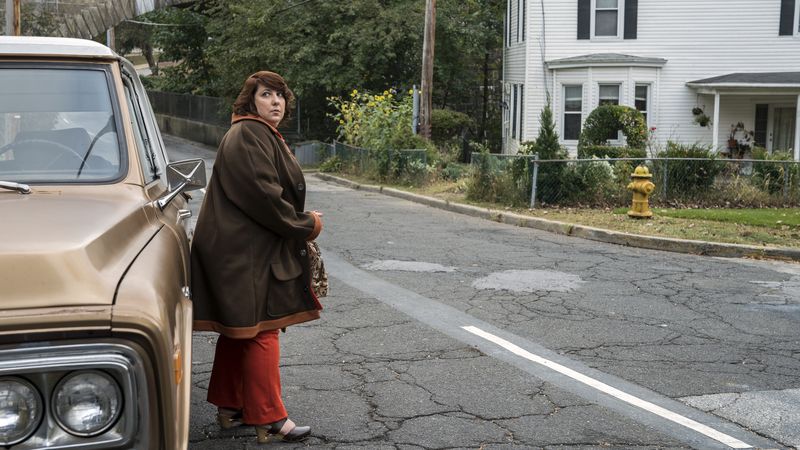 Ashlie Atkingson as Connie, in Spike Lee's "BlacKkKlansman".
David Lee/Focus Features
Ashlie Atkingson as Connie, in Spike Lee's "BlacKkKlansman".
David Lee/Focus Features
"BlacKkKlansman" opens in the UK on Friday. Spike Lee's film continues its
expansion across the U.S. and Canada.
COPYRIGHT 2018. POPCORNREEL.COM. ALL RIGHTS RESERVED.
FOLLOW
MOVIE REVIEWS |
INTERVIEWS |
YOUTUBE |
NEWS
|
EDITORIALS | EVENTS |
AUDIO |
ESSAYS |
ARCHIVES |
CONTACT
| PHOTOS |
COMING SOON|
EXAMINER.COM FILM ARTICLES
||HOME