MOVIE REVIEWS |
INTERVIEWS |
YOUTUBE |
NEWS
|
EDITORIALS | EVENTS |
AUDIO |
ESSAYS |
ARCHIVES |
CONTACT
|
PHOTOS |
COMING SOON|
EXAMINER.COM FILM ARTICLES
||HOME

Tuesday, September 4, 2018
ESSAY/BlacKkKlansman
An Atmosphere Of Everyday Hate Igniting Deadly Fuses

Thousands of everyday white people in Waco, Texas on May 15, 1916, dressed in
their Sunday bests, including children, watch the torture, lynching and
dismemberment of mentally-challenged 17-year-old boy Jesse Washington, accused
of raping a white woman. This still appears in Spike Lee's latest film
"BlacKkKlansman".
Guildersleeve
by
Omar P.L. Moore/PopcornReel.com
 FOLLOW
Tuesday,
September 4,
2018
This is the second in a series of essays on Spike Lee's Cannes-winning Grand
Prix film. Contains spoilers.
The atmosphere of hate is weaved, one image then another, then another,
established so proficiently in the first five or six scenes of Spike Lee's
brilliant "BlacKkKlansman". The hate is cinematic, cultural, current,
instructional, institutional and insidious. This is the set up. The
film's early, seemingly incongruous yet very tightly-woven coherent images
belong as the start of an American throughline of racism, hatred and white
supremacy. Mr. Lee's film, visceral as it is, builds a psychology,
ideology, attitude and language of hate as powerful, toxic atmopshere.
This is the fuse.
In "BlacKkKlansman" the Klan commit very little if any actual physical violence
at all. They certainly have terrifying, deadly plans for the Colorado
College Black Student Union, who teaches its members to be aware of history and
the present and to liberate and empower themselves against racism, hatred and
violence with Black Power. Jerome Turner (played by human rights activist
and actor/musician Harry Belafonte) tells the gruesome true-life story of Jesse
Washington, a Black 17-year-old mentally-challenged boy who was tortured,
lynched, dismembered, sold in pieces and postcarded in Waco, Texas.
The Klan did not desecrate or kill young Jesse -- ordinary, everyday non-hooded
white citizens did. Thousands and thousands of everyday white people watched, cheering on
those white men who repeatedly dropped an oil-slicked Washington into a paroxysm of flames. This violence "was done by teachers and clergy and law
enforcement officers," Brian Stevenson of the Equal Justice Initiative told
Oprah Winfrey on "60 Minutes" last April.
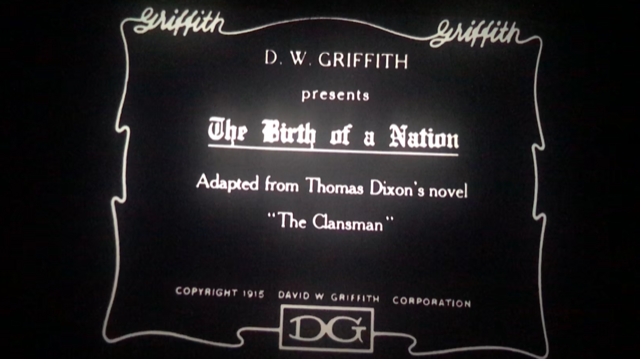 A
screenshot from "BlacKkKlansman" of D.W. Griffith's racist film "Birth Of A
Nation", which the Klan used as a recruiting tool.
A
screenshot from "BlacKkKlansman" of D.W. Griffith's racist film "Birth Of A
Nation", which the Klan used as a recruiting tool.
Those 15,000 white people who cheered Mr. Washington's inhumane ordeal in person
on May 15, 1916, one year after the release of "Birth Of A Nation", are
representative of "the
vast, heedless, cruel, unthinking white majority" James Baldwin spoke of in the
early
1960s. It is perhaps this same majority today, in Donaldland America that
Spike Lee is speaking to with "BlacKkKlansman". Yet it is also those who
think that they don't think the way racists do who the director shakes out of their
very dangerous comfort zone. After all, it would be too easy to caricature
the Klan and its sympathizers as one-dimensional. It would be too lazy or
convenient to do so. Instead Mr. Lee shrewdly makes the Klan as ordinary
as possible, as ordinary as the white person who may watch Mr. Lee's film.
Some of the Klan members are rendered charismatic and persuasive, for maximum disturbing
wolf-in-sheep's-clothing effect.
For some white people in the audience the use of the word N as it is repeatedly
uttered in "BlacKkKlansman" will be familiar, as they have either uttered it
themselves or heard spouses or other family members say it. The only
violence that the Klan commits throughout most of Mr. Lee's film is in their
repeated use of N. A sickening sledgehammer every time N is said.
On the other side of that word was the physical violence against Black people
across America that was sure to
follow.
It is the atmosphere created by that unforgivable word, by the daily racist
comments and jabs made by whites to Blacks in an office, in a records division in the Colorado Springs
Police Department, by the Nixon "silent majority" law and order "Now. More
Than Ever." posters and the "Re-Elect Nixon/Agnew" posters that frame the walls
at a Klan initiation, that raises "BlacKkKlansman" from any risk of artifice and
convention to
authenticity and culpability.
The societal insignia is a second hand vocabulary that becomes first nature in
"BlacKkKlansman", a self-conscious reinforcement of the institutional white
supremacy and racism that is constant in America, ingrained in its culture,
language, speech and customs. Cinema, sometimes a potent corrective of
imagemaking, provides an important role of framing, reframing and perception.
And with "BlacKkKlansman" it is always the things in the cinematic background that are more
dangerous and suggestive than what you see right in front of you. Until it
isn't.

The Klan initiation scene featuring Topher Grace (center, in blue cape) as Klan
Grand Wizard and National Director David Duke in Spike Lee's "BlacKkKlansman".
Focus Features
All of the code words, the racist dog-whistling, the propaganda of "Birth Of A
Nation", the racist and stereotypical presumptions about "BlacKkKlansman" main character Ron Stallworth's sexual
proclivities and intelligence ("against my better judgment", the racist police
Chief Bridges, who never says N) -- lead to the film's finale where real present-day
violence and terror is unleashed literally in your lap. By this time the
foundations have been laid firmly throughout two hours of "BlacKkKlansman"
sufficiently fertilized for maximum power keg effect, a towering tree of hate
has come crashing through the big screen in shocking fashion. The hate, in
the form of video footage, is especially powerful and plaintive. Some of the footage
that had not been shown on August 12, 2017 or thereafter, was owned by corporate
news media in America. Why wasn't it shown to the general public at large?
Showing Klan violence at any point prior to the Charlottesville finale in
"BlacKkKlansman" would have weakened the atmosphere Mr. Lee so carefully and
meticulously crafts. He uses video of the deadly terrorist events of
Charlottesville 2017 as the ultimate counterpunch to D.W. Griffith's "Birth Of A
Nation" epic. The filmmaker uses Mr. Belafonte's onscreen character's
real-life story about Jesse Washington's horrific fate as a further refutation
of the racist 1915 film, which has created a psychological violence of its own
against Black people in the U.S.
It should be noted: at least two books on World War Two are situated on a bookshelf right behind
Colorado Springs Police Chief Bridges (Robert John Burke), nearby his head. Does Chief Bridges
subscribe to Nazism? After all, he talks about "one of my guys" and "my men"
(both read: white) as opposed to "Ron" (the only Black police officer on the Colorado
Springs force.) Chief Bridges's lexicon is more Bull Connor than anything.
It is the set dressing by Curt Beech, his production design, that sets up this
atmosphere of hate exceedingly well. The books behind Chief Bridges and
those behind Topher Grace's David Duke, the racist cardboards of
Black figures used for target practice. The "white pride" car bumper
sticker. The "America: Love It Or Leave It!" sign. The Confederate Battle Flag in many scenes, including in "Gone
With The Wind" and throughout Mr. Lee's film.
Without the subtle and not-so subtle insignia that permeates "BlacKkKlansman"
the finale and the film as a whole wouldn't have the sufficient resonance
needed to jolt audiences into reality and attention about white hatred
re-ramping up and literally killing people in America. The fuse is lit.
It crackles. And finally, with deadly Charlottesville terrorism the fuse explodes in your face
across the big screen, in all its unblinking cold-blooded horror.
The previous essay in this series was the first essay entitled
"White Women As A
Throughline In BlacKkKlansman"
COPYRIGHT 2018. POPCORNREEL.COM. ALL RIGHTS RESERVED.
FOLLOW
MOVIE REVIEWS |
INTERVIEWS |
YOUTUBE |
NEWS
|
EDITORIALS | EVENTS |
AUDIO |
ESSAYS |
ARCHIVES |
CONTACT
| PHOTOS |
COMING SOON|
EXAMINER.COM FILM ARTICLES
||HOME